
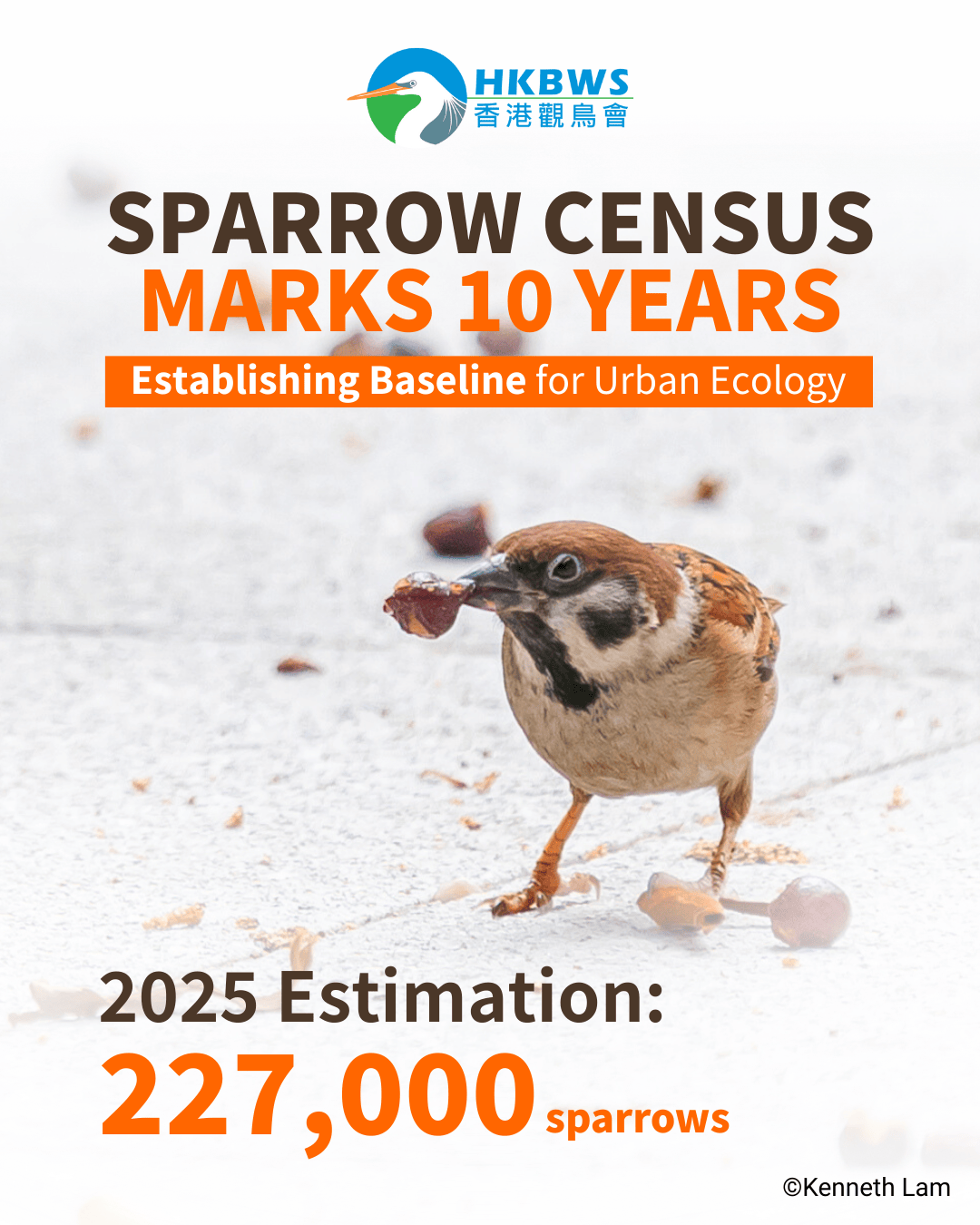
Hong Kong Sparrow Census Marks 10 Years:
Establishing Baseline for Urban Ecology
with over 2,600 Citizen Science Participations
The 10th Hong Kong Sparrow Census estimated that, in 2025, the number of Eurasian Tree Sparrows (referred to as “sparrows” below) is approximately 227,000 in urban areas of Hong Kong, with a slight increase of 2.3% compared to last year. Sparrow numbers have remained stable within the range of 210,000 to 260,000 for eight consecutive years.
As the Census entered its tenth year, HKBWS noted that the project has accumulated over 2,600 participations, enabling the collection of a decade-long dataset through public involvement. This dataset provides a reference baseline for understanding the typical population level and natural fluctuations of sparrows in Hong Kong, and offers a foundation for identifying and assessing unusual changes in the future. Looking ahead, HKBWS will continue to promote citizen science training and expand the scope of urban bird monitoring.
Sparrow Population Remains Stable with Nearly 40% Found in Recreational Areas
The census was conducted from May 10 to 24, 2025, covering six land uses across 18 districts in Hong Kong (residential, commercial, industrial, recreational, agricultural and rural areas). A total of 315 members of the public participated as volunteer surveyors, counting sparrows along 80 pre-defined routes, approximately one kilometer each, in the early morning. The data were used to estimate sparrow density and extrapolate the overall population.
Results indicate that around 227,000 sparrows were recorded in urban Hong Kong in 2025, with an annual increase of 2.3%. Among the 18 districts, Yuen Long recorded the highest sparrow density, with an average of about 100 individuals per survey route, followed by Tuen Mun and Sha Tin.
By land use type, the highest number of sparrows was found in recreational areas, with an estimated 89,000 individuals, accounting for nearly 40% of the total population, followed by residential and rural areas.
A Decade of Data Provides a Reference Baseline
Since 2018, the overall sparrow population in Hong Kong has remained within the range of 210,000 to 260,000, with no statistically significant upward or downward trend observed. According to Anson Tse, the Research Officer at HKBWS, “Ten years of continuous monitoring have allowed us to establish a baseline that reflects the general population level and natural year-to-year variation of sparrows in Hong Kong, providing a point of reference for identifying potential anomalies in the future”
Nevertheless, the long-term data reveal declining sparrow density in certain areas. Among the 18 districts, four districts showed a clear downward trend, including three in Hong Kong Island and one in Sham Shui Po. By land use type, industrial, commercial, and agricultural areas also recorded declines in sparrow density. Tse noted that while these changes do not constitute an overall citywide trend, their underlying causes remain unclear, and further monitoring through expanded survey routes is proposed.
Over 2,600 Participations in Ten Years Foster Cross-generational Citizen Science
Over the past decade, the Census has accumulated more than 2,600 participations, with participants ranging in age from 6 to 80 years old. More than 120 individuals have taken part in the Census for two or more times, with the most experienced participant joining on seven occasions. Participation in 2025 reached 315 volunteers, marking the third consecutive year of growth and a new post-pandemic high.
Arthur Yu, the Assistant Education Manager at HKBWS, remarked, “The value of citizen science lies in sustained observation over time. One of the key gains of the Sparrow Census is the gradual formation of a cross-generational community that continues to take part in long-term monitoring.”
Expanded Urban Bird Monitoring Scope to Promote Urban Biodiversity
The Urban Bird Census, now in its sixth year, continues to monitor four common urban bird species: Spotted Dove, Oriental Magpie Robin, Red-whiskered Bulbul, and Red-billed Blue Magpie.
The Oriental Magpie Robin was estimated at around 27,000 individuals, showing a notable increase of approximately 10,000 individuals over the past two years, although its long-term trend requires continued observation.
By land use type, Oriental Magpie Robin, Red-whiskered Bulbul, and Red-billed Blue Magpie recorded their highest densities in rural areas, a pattern different from that of sparrows. This may reflect differences in how bird species respond to varying degrees of urbanisation and environmental conditions. To broaden understanding of urban biodiversity, HKBWS plans to expand the Urban Bird Census next year to include additional species such as Asian Koel, Oriental Magpie, Crested Myna, and Black-collared Starling.
Call for Bird-friendly Cities
Yu encourages the community to adopt more bird-friendly practices to support urban biodiversity, including reserving spaces with ecological function in urban planning and building design, increasing the proportion of native vegetation, reducing unnecessary pesticide and herbicide use, and safeguarding breeding habitats against disturbance.
The Hong Kong Sparrow Census will recruit volunteers again in spring next year, with surveys expected to take place in May. Members of the public of all ages and backgrounds are invited to take part and contribute to building a long-term urban bird database, helping common birds remain common. Recruitment details will be announced via the HKBWS website and social media platforms.